The AI Automation Spectrum: From Workflows to AI Agents
- Eric Granata

- Mar 20
- 5 min read

Originally featured on PromoPilot
Automating company stores has come a long way. Not long ago, many of us were excited just to set up simple “if X, then Y” routines to save time. Now all the rage is about smart AI agents that can handle tasks almost like a human assistant. If you're new to these terms, it may feel confusing. The good news is there's a clear way to understand how automation is evolving.
It's called the AI Automation Spectrum, and it’s basically a range from straightforward, rule-based workflows to intelligent AI-driven agents. If you’re running Liftoff Commerce stores, this spectrum maps directly to how you operate today – and where you can go next. In this overview, we'll explain what that spectrum is, how it relates to automation, and how Liftoff and Zapier can work together throughout the AI Automation Spectrum.
What is the AI Automation Spectrum?
Think of the AI Automation Spectrum as a line with two ends: on one end is deterministic automation (the classic "follow the rules exactly" approach), and on the other end is inference-driven AI (automation that can make its own context-aware decisions). This concept illustrates a framework that shows how automation can range from having zero "brain" (just following preset rules) to having a lot of "brain" (AI that figures things out on the fly).
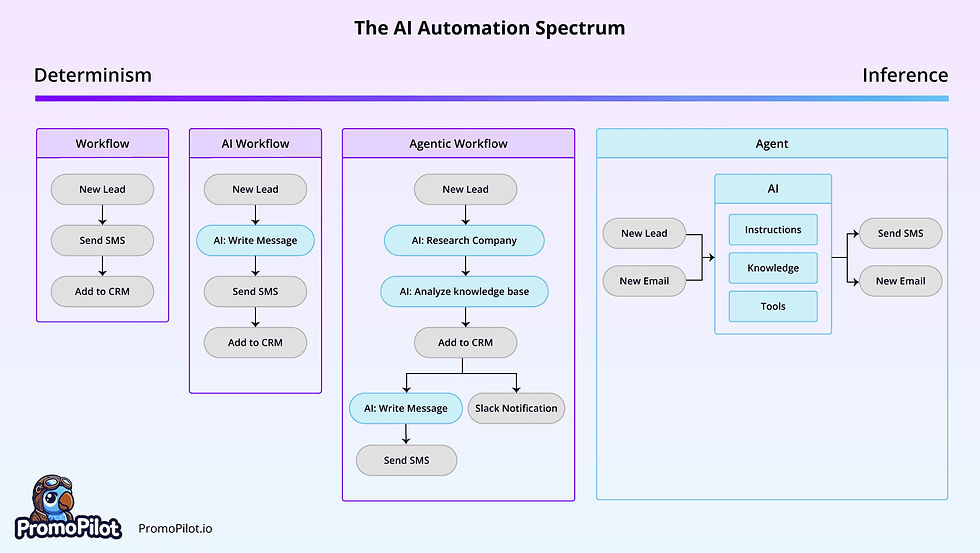
The Four Levels of Automation
Let's break down the spectrum into four basic levels, from the simplest automation to the most intelligent:
Workflow (Deterministic Automation): This is your basic automation with zero "thinking" involved. The process follows a strict, pre-defined sequence of actions every time. For example, you might set up a workflow so that when a table cover is ordered, a predefined email with laundry and return instructions is sent to the customer. There's no AI here – it's just if-this-then-that rules, which makes it fast and reliable for routine tasks.
AI Workflow (Automation with a Hint of AI): Here, the overall workflow is still pre-defined, but you let AI handle one step of the process. In other words, it's a normal automation "with a sprinkle of AI." For instance, you could keep the same laundry and return workflow as above but use an AI to generate the email instead of using a fixed template. The structure (when product is ordered → email customer) doesn't change, but an AI adds a bit of intelligence at one point (maybe using additional captured information like event date and location to further customize the email). This makes the automation more adaptable without losing predictability.
"Agentic" Workflow (Automation with Multiple AI Decisions): At this level, you still have a clear workflow structure, but the AI steps in at several points to make judgments or decisions. It's a blend of automation and AI working within set guardrails. Continuing our example, when a table cover is ordered, the AI might first evaluate the customer and order context (new vs repeat customer, event timing), then decide how detailed the instructions should be, generate a tailored email, and optionally notify your team if the order looks high-risk. There are multiple AI-driven actions, but they occur in a sequence you've outlined. This approach handles more complex tasks (with the AI adapting to context) while still following a reliable pattern you control. It's not only generating content this time – it's taking action by conducting research and getting information from Liftoff.
Agent (Autonomous AI Assistant): This is the far-right end of the spectrum – an AI agent with a lot of autonomy. You don't script out the entire workflow step by step; instead, you give the AI a goal or high-level instruction, and the agent decides how to achieve it. It's like putting the AI on autopilot (with some safety boundaries in place). In our example, you might tell the agent, “Make sure table cover orders are handled correctly.” From there, it could decide when to send instructions, follow up after the event to prompt a return, notify your team if the item hasn’t been sent back, and update your systems accordingly – all based on context, without you defining each step. This level is the most powerful and flexible, but it’s also the least predictable. Fully autonomous agents are exciting, but they require good guidance (and often a bit of oversight) to ensure they stay on track.
Where do platforms like Zapier fit in?
Platforms like Zapier have traditionally lived on the left side of the spectrum, helping teams build reliable, rule-based automations that connect systems. In a Liftoff environment, that might look like moving order data into your ERP, triggering emails, or syncing customer records across tools.
But that’s no longer the full picture.
Zapier now supports AI steps inside workflows, which moves it into the AI Workflow level – things like generating customer communications, summarizing orders, or classifying data as it moves between systems. From there, Zapier Agents push further into the spectrum, allowing AI to take on multi-step decision-making within your processes.
With the addition of Zapier MCP (Model Context Protocol), you can even connect ChatGPT, Claude, and other AI tools to Liftoff and thousands of other integrated apps.
Automation is no longer about simply moving data between systems. AI orchestration helps you reason about it and act on it.
Choosing the Right Level
The spectrum isn’t about chasing the most advanced solution – it’s about using the right tool for the job.
If the task is repetitive and predictable, a workflow is enough
If it needs better communication or interpretation, add an AI step
If it requires judgment across multiple points, move to an agentic workflow
If you're feeling ambitious, consider an agent
Most of the value comes from moving one step to the right – not jumping all the way.
Start Small, Then Expand
You don’t need to redesign your entire operation to take advantage of this.
Start with something simple:
Add AI to an existing Zap
Improve one communication touchpoint
Introduce a small amount of decision-making
From there, you can layer in more intelligence as needed.
Bringing It Back to Liftoff
If you’re running company stores in Liftoff, you already have the foundation.
Liftoff's Zapier integration gives you access to the full spectrum – from basic workflows to more advanced, AI-driven automation. The opportunity is deciding where to apply it so it actually reduces friction in your day-to-day operations.
If you need access to the Liftoff Zapier integration, reach out to your Liftoff account manager for an invite.
And if you need help designing or implementing these workflows, PromoPilot can help you put it into practice.


